
From Retail to Recruitment: Why Retail Experience Can Make You a Great Recruiter
From Retail to Recruitment: Frazer Ansell
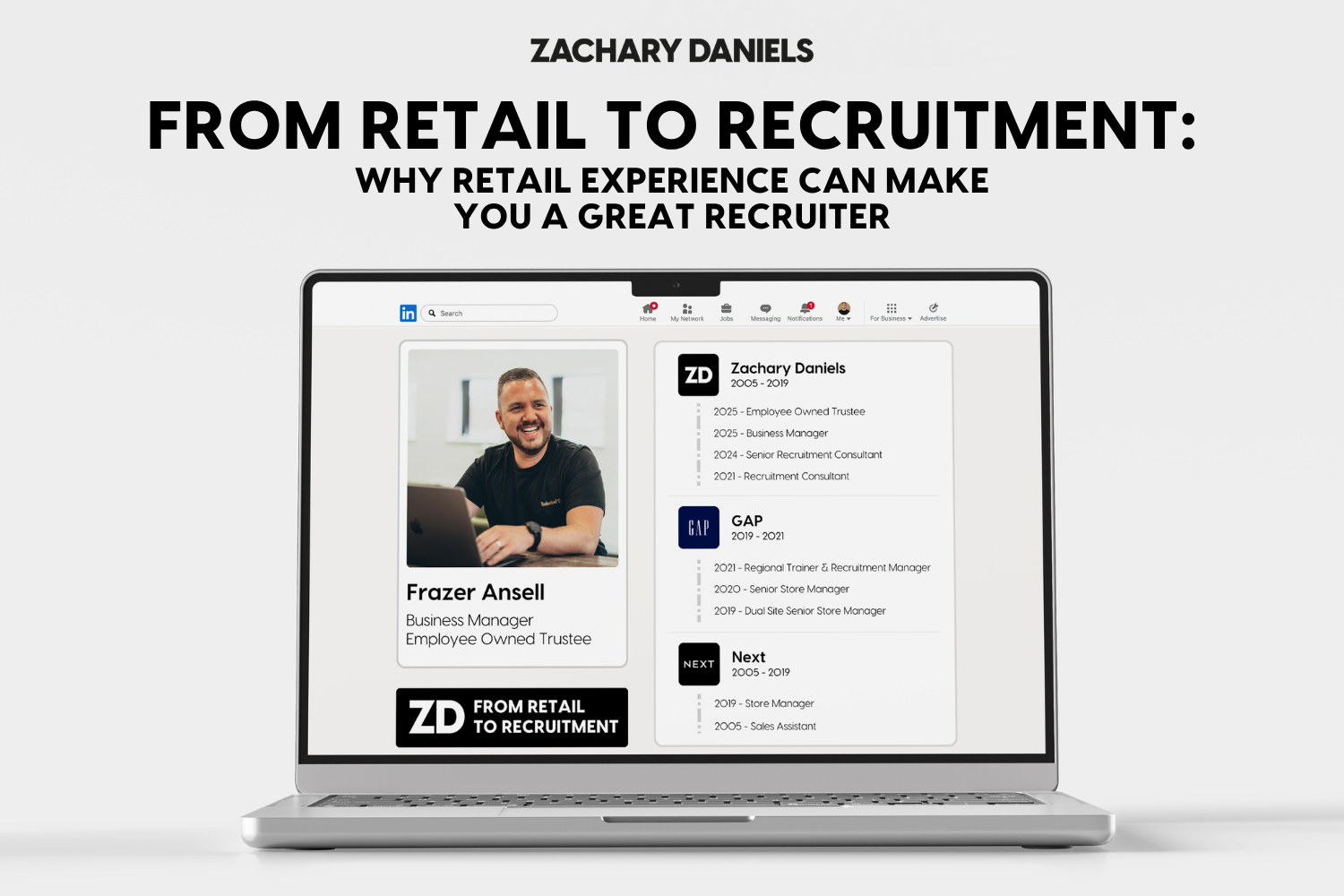
Frazer Ansell spent 15 years in retail, working his way from Sales Assistant to Senior Store Manager before recruitment was ever on his radar.
Today, he’s a Business Manager at ZD, recruiting into the same industry he spent years working in.
And he’s not the only one. A number of our team worked in retail, or within the specialist areas they now recruit for, before joining ZD.
So, does that experience actually make a difference? We asked Frazer what he still uses from his retail career today, and why he thinks more people working in retail should consider where else their experience could take them.
Why does retail experience matter when choosing a retail recruitment agency?
If you’ve ever briefed a recruiter on a Store Manager or Area Manager role and found yourself having to explain the basics of how your stores operate, you’ll probably understand why industry experience can help.
For Frazer, it means he’s often starting the conversation with context already there.
“Having done the job gives you a lot more confidence in the conversations. You’re not learning the job from scratch, you already know it. There’s a level of credibility that comes from being able to say, I’ve done that job.”
That comes through in the everyday conversations. He understands the difference between running a mainline store and an outlet, what a multi-site role actually involves and the realities behind delivering a retail operation that customers rarely see.
It also helps when he’s assessing candidates. He’s sat on the other side of the table, recruited people into his own teams and knows that sometimes the right person doesn’t necessarily look like the obvious person on paper.
Area & regional management page
What transferable skills do retail professionals already have?
Anyone who’s managed a store, a section or a team has already built a set of skills that translate a long way beyond retail, often without realising it. Frazer’s own experience points to a few in particular:
- Reading people: retail puts you in front of different personalities every day, from customers and colleagues to senior managers. You learn pretty quickly that the same approach doesn’t work with everyone.
- Resilience: people call in sick, deliveries don’t arrive, targets get missed and plans change. You learn to deal with what’s in front of you and keep moving.
- Commercial ownership: Store Managers are responsible for targets, budgets, people and performance. That sense of ownership translates surprisingly well into running a recruitment desk.
- People management: recruiting, onboarding, coaching, developing people and having difficult conversations are already part of the job for many retail managers.
- Problem-solving: retail rarely runs perfectly to plan. Being able to think on your feet and find a solution is useful in recruitment too.
What is it actually like moving from retail into recruitment?
It’s worth being honest about this, because the idea of “recruitment” puts a lot of good candidates off before they’ve properly looked at it.
“I expected recruitment to be a lot more sales-focused than it actually is. What surprised me is how much the role is actually about relationships: building long-term relationships with candidates and clients, understanding what motivates them, even when there isn’t a quick win to be had.”
The part of the job that felt genuinely new to Frazer wasn’t the people side, it was business development. “In retail, you’re representing a brand, a whole team, it’s not just you,” he explains. “In recruitment, if you want to win a new client, it’s almost, why should they use me? I had to learn how to sell myself, and that was something I’d never done before.”
What Frazer realised was that business development didn’t have to mean becoming the pushy salesperson he’d always associated with recruitment. For him, it was much more about building relationships, staying in touch and being there when someone did eventually need help.
What should you consider before leaving retail for recruitment?
Moving from a retail career into recruitment isn’t a decision to make lightly, and Frazer is candid about what it actually takes:
- You’ll have plenty to learn. Frazer joined ZD with zero recruitment experience, so there was a completely new job to get his head around. What he didn’t have to learn was retail.
- You need to be genuinely willing to learn it. Recruitment has its own processes, tools and pace to pick up, and that takes time.
- You have to want it. Retail skills give you a head start, but the move still requires commitment, as Frazer puts it, “if you’re not all in, it’s going to be tough.”
- Consider what you actually enjoyed about retail. If it was the people, the commercial challenge and building relationships, those are the parts of the job that carry across most directly.
Is retail experience a good foundation for a recruitment career?
It certainly can be.
If you’ve managed people, worked to targets, dealt with customers, recruited into your own team and taken responsibility for the performance of a store, you’ve already developed a lot of skills that are useful in recruitment.
It doesn’t mean recruitment will automatically be right for you, and there will be plenty to learn. But moving careers doesn’t necessarily mean throwing away everything you’ve already built.
As Frazer puts it:
“I didn’t need to relearn retail. It was like having a bit of a cheat code.”
Why does sector experience matter when you’re hiring?
For clients, it means we’re often starting the conversation from a different place.
When you’re briefing us on a role, we’re not just listening to the job title and salary. We understand a lot of the context around it: the environment, the pressures, the type of person who might thrive there and why someone who looks right on paper might not necessarily be right in reality.
And for candidates, it means they don’t have to spend half the conversation explaining what their job actually involves.
We don’t believe every great recruiter has to come from industry. But having people in our team who’ve actually worked in the areas we recruit for gives us another layer of understanding, and Frazer’s career is a pretty good example of that.
FAQ
Do I need recruitment experience to move from retail into recruitment?
No. A lot of the skills that can make someone good at recruitment (relationship-building, reading people, communication, resilience) are already being developed in retail. Recruitment-specific knowledge, like process and the sales side of the role, can be taught on the job.
What retail skills transfer best to recruitment?
Commercial awareness, people management, resilience and emotional intelligence tend to transfer most directly, along with a genuine understanding of the roles and pressures involved in retail careers.
Is recruitment a sales job?
There’s a commercial element, particularly around business development, but consultants who’ve come from retail, like Frazer Ansell, often find the day-to-day is built more around relationships than hard selling.
Do I need to have worked in recruitment before applying for a recruitment role?
No. Frazer joined ZD with zero recruitment experience, and he’s not unusual in that. We look for people who understand their industry and are willing to learn recruitment on the job, not people who already have a recruitment background.
Could your retail experience take you somewhere different?
Frazer spent 15 years building a career in retail before something completely different came along.
Five years later, he’s a Business Manager at ZD and still uses the experience he built in stores every day.
If recruitment is something you’ve never considered but you’d like to understand what it actually involves, we’d be happy to have a chat. No polished recruitment CV required.
< Back to list

